

How to Build a Distribution Strategy: From Market Overview to Channel Decision
How to get from a market overview to the right channel decision, in a market where most buying now starts on a screen. The method is the evidence.
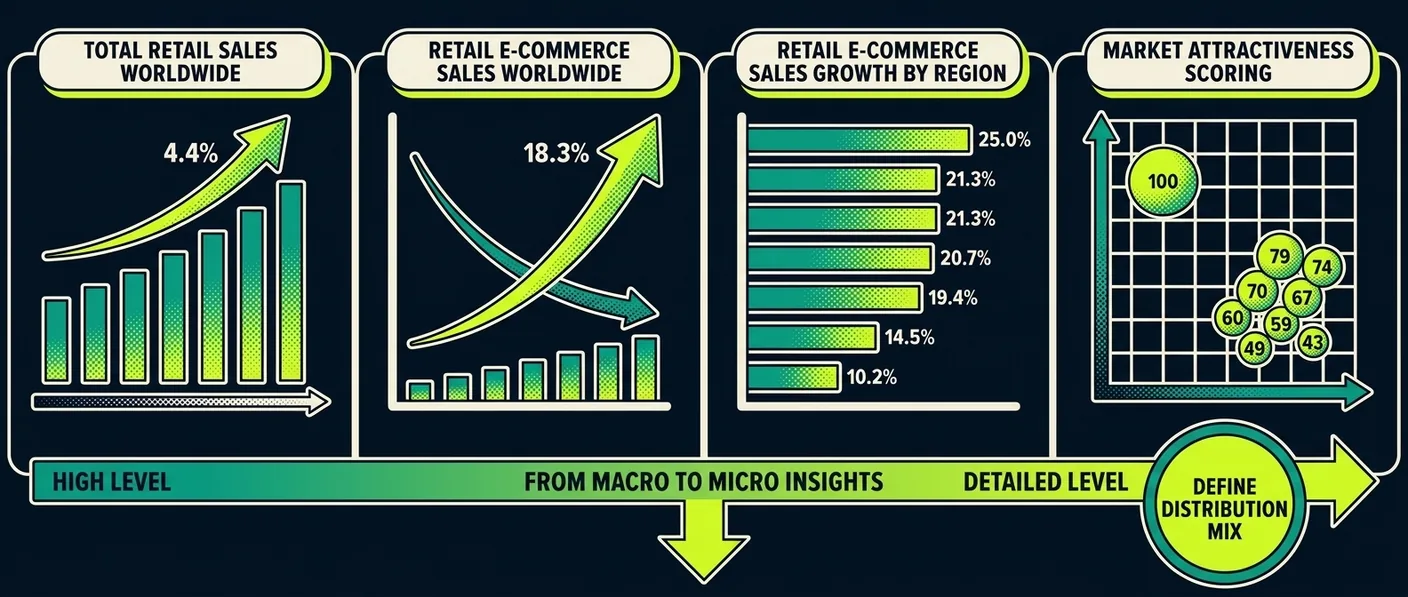
A distribution strategy answers one question before any channel is chosen: where do we sell, and why. This is how we work from a market overview down to a channel decision, the way we prepare market-entry decisions in corporate development.
01What is a distribution strategy?
A distribution strategy is a reasoned decision about where a company sells and why each channel is there. It is not the same as picking channels. It sits above the channel level and answers a portfolio question: which channels, in which role, serving which purpose.
Most companies confuse this with having an online store. Having a store is a fact. A distribution strategy is a set of choices about the whole selling surface, made deliberately and defensible against the question “why this channel and not another”.
A distribution strategy is not a list of channels. It is a reasoned decision about where you sell and why.
02Why is distribution a strategic question today?
Distribution is a strategic question today because commerce has moved and the question of where a company sells at all is genuinely open again. For years the answer was assumed. It no longer is.
Several movements drive this at once. Direct-to-consumer lets brands sell straight to the end customer and keep control of experience, margin and data. The customer journey now runs across platforms, no longer linear, no longer confined to one channel. Conversational commerce turns chat and messaging into a selling channel of its own. Social platforms have stopped being pure reach and become selling surfaces. Product search increasingly starts on a marketplace rather than on Google. And process automation is what makes running several channels economically viable in the first place.
Put together, the question has changed. It is no longer “do we have an online store”. It is “which channels, in which role, with which purpose”. That is a strategic decision, not a technical one.
03How do you analyse a market from macro to micro?
You analyse a market from macro to micro by working from the total market down to a single channel decision, in a fixed order, so that each stage narrows the next. A sound distribution strategy does not pick channels on instinct. It reasons its way down.
The first step keeps you honest. Understanding the total market stops you optimising inside a segment that barely matters in the wider picture. The second separates the market you could sell in from the market where customers already buy digitally. The third respects that a world market is not a uniform market: a mature market with a high online share calls for a different distribution than a growing one where commerce is only now going digital.
04How do you score market attractiveness?
You score market attractiveness by measuring how much a market is worth against how realistically you can serve it, so that markets become comparable instead of judged one at a time. This is the analytical core, and attractiveness is not the same as size.
A large market can be unattractive when it is saturated or hard to reach. A smaller market can be attractive when it is growing and open. We score attractiveness against reachability: one tells you whether the market is worth it, the other whether you can actually serve it. Established assessment frameworks such as the Global Retail E-Commerce Index and the United Nations E-Commerce Index give this a systematic basis. The result is a score that ranks markets against each other. This scoring logic is what we carry over from corporate-development work, where market-entry and distribution decisions are prepared exactly this way.
At the end of this path stands the actual decision: the distribution mix.
05Which channels belong in the distribution mix?
The channels that belong in a distribution mix are the ones that earn a purpose, not the ones you can technically be present on. The mix follows from the market score, and it is purpose-led: every channel carries a job, not just revenue. Wanting to occupy every channel is the mistake. Assigning each channel a purpose is the discipline.
- 01Brand.com, the own store: commerce and education, with full control of brand experience and customer data.
- 02Social platforms: loyalty, trust and awareness, and increasingly direct conversion.
- 03Marketplaces: growth, reach and volume where customers already search and buy.
- 04Wholesale, online and offline: growth through partners who bring their own reach.
Within the mix it pays to distinguish by who operates the channel and who owns fulfilment. A digital flagship is your own transactional presence in core markets, set up locally. Digital concessions are selected partners running their own merchandising under a mandatory brand style guide. Wholesale partners run their own e-commerce, and online-pure-players do the same as a wholesale channel with the style guide still mandatory. Marketplaces sit as wholesale or retail depending on the model, and social commerce sells directly on the leading platforms.
The taxonomy is not about completeness. It is about clarity. For every channel it must be settled who steers it, who ships, and what purpose it serves, and this is exactly where channel steering and partner work earn their place. That is the difference between a mix that follows from a strategy and a collection of channels that grew by accident.
06From market overview to decision
The synthesis is simple to state and hard to hold to: the strategy decides the portfolio, the tactic optimises a channel. A distribution strategy derives its channel decisions from market analysis, not from the fear of missing a channel.
The tactic asks “how do we sell better on a given marketplace”. The strategy asks “does that marketplace belong in our mix at all, and if so, with what purpose alongside which other channels”. One improves a single surface. The other decides which surfaces exist.
We have run this method in two very different contexts. In B2C fashion e-commerce, where the balance of own store, social and marketplaces decides margin and brand control. And in B2B with self-adhesive materials and labeling devices, where wholesale and direct channels are weighed against each other. The steps stay the same. What changes is the weighting of channels by market and purpose.
The strategy tells you which channels to run and why. How you then organise, staff and steer them is the operating model, and that is the subject of a separate piece we are preparing.