

Digital Retail Partner Management: manage retail partners on the data trail
Digital Retail Partner Management turns the terms negotiation into measured, joint planning. We show you what each partner actually does with your brand before you negotiate the first data access.
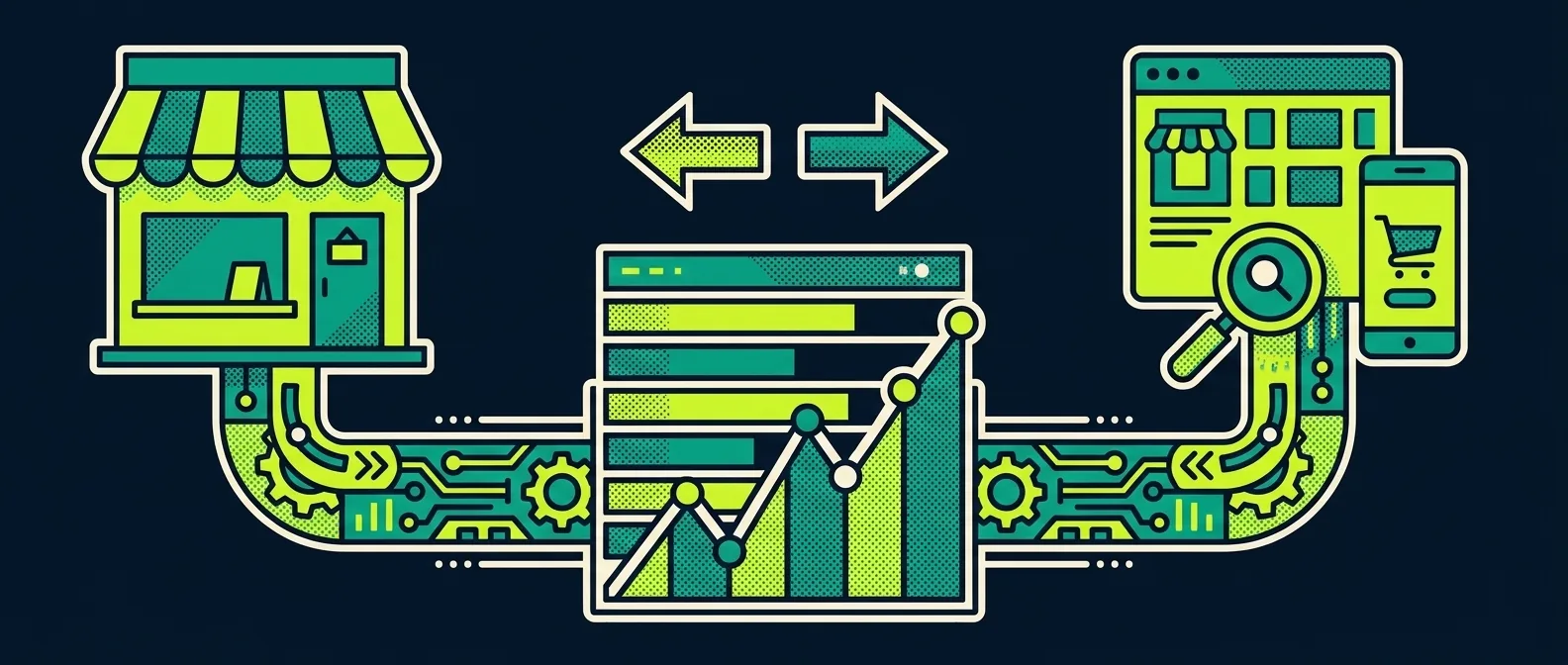
Most manufacturer relationships with retail run on two meetings, the annual review and the escalation somewhere in between. What a retail partner actually does with your brand between those dates, how visible it is in their channels, whether the agreed investments deliver, remains gut feeling.
That used to be unavoidable. It no longer is. Retail has gone digital, even where the purchase ends up happening in-store, and digital channels leave a measurable trail. Digital Retail Partner Management means steering the partnership on that trail instead of on the annual calendar.
Measure the relationship only at the shelf and you see the end of the journey and mistake it for the whole.
01Why are in-store and digital no longer separable?
In-store and digital are no longer separable in retail because the same purchase decision now runs across both layers. Physical retail is not losing relevance. It is changing its role. Stores become showrooms, service points and fulfilment nodes for online orders, while the early phases of the purchase decision, the browsing, comparing and checking, increasingly happen digitally.
Your retail partner’s website has become as important as their shelf space. Whoever wants to steer the whole Customer Journey has to see both layers.
02How do we measure partners without asking for data?
The outside view measures a retail partner without any data access from their side, purely from publicly observable signals. A substantial part of partner steering needs no data agreement at all. We capture three things, for every partner, in every market, repeatably.
- 01The partner's traffic mix by source, per market and over time.
- 02Search visibility and your brand's share of it, measured against the competitors standing right next to you there.
- 03Your brand's presence in the partner's shop, from entry through search, category and product page to checkout.
This outside view changes the annual review. You arrive with a measurement instead of an impression. You see before the negotiation which partner is building reach and which merely claims it, where your visibility belongs to a competitor, and which channels the partner does not serve at all. It is captured with standard competitive-analysis tooling, without the partner having to do anything.
03How do we develop partners instead of just demanding?
Developing partners means turning the findings of a partner check into an action catalog that the brand actively offers the partner. The measurement is half the service. The other half is what comes of it.
From the findings we build a catalog of concrete actions: search visibility, the shop’s technical foundation, findability and quality of the product pages, checkout. Every action with a defined benefit for the partner, clear ownership, a realistic timeline and a target figure both sides can read success from. We describe the structure behind this in our action catalog for trade marketing.
- 01Complete one action and show its effect before the next one starts. The partner experiences the benefit before carrying the next effort.
- 02Follow-up is part of the action, with fixed checkpoints for execution and result, not an occasional query.
This turns the role around. The brand shows up at the partner as the one who measurably contributes to their business. That is the most resilient negotiating position there is in retail.
04How do we secure data exchange with the partner?
The inside view secures data exchange by making it a condition of investment rather than a request. This layer needs the partner: sell-through data at short intervals, performance data on joint activities, conversion data from the retailer’s channels. This data does not flow by itself. It flows when it is agreed up front which metric each activity is expected to deliver, and who supplies it.
05What does the Partner Scorecard make visible?
The Partner Scorecard brings the outside and inside views together in one reporting model and makes cost, effect and return comparable per action. Both views stay piecemeal as long as they live in exports and slide decks.
We build the scorecard along the journey, from awareness through purchase intent and checkout to repeat purchase, each stage with volume, efficiency and impact metrics. That makes comparable what today mostly sits side by side: what an action costs, what it achieves, and what it contributes to the business. We explain the underlying metric logic in our overview of e-commerce KPIs.
The yardstick shifts from cost control to return. Which partner carries the next investment, and which no longer does.
06Why does Retail Media make steering mandatory?
Retail Media makes steering mandatory because retailers now price visibility item by item, and brand manufacturers become the partner’s customer as well as their supplier. Ad placements, data access and positioning are billed separately. Whoever buys there without being able to measure effect is paying for visibility on demand.
And there is a new layer on top. AI assistants are beginning to complete purchases directly, over open protocols that the major platforms now support. This is a channel neither brand nor retailer owns, and it puts a new question to partner steering: which partner is even connectable for this agent channel, with clean product data, current availability and machine-readable prices. Agent connectivity becomes an assessment criterion in the partner portfolio.
Digital Retail Partner Management is the answer: defined return, agreed measurement, continuous control. Not distrust of the partner, but the form of professionalism that leaves both sides better off.
07What you get
You get five deliverables that turn the terms negotiation into joint planning. Each stands on its own and feeds into the next.
- 01An inventory of your retail partners from the outside view.
- 02A partner check with an action catalog that turns findings into a development program per partner.
- 03A data baseline for exchange with the partners who can carry it.
- 04A Partner Scorecard that brings the outside and inside views together.
- 05The structure for the annual review, following the logic of the Joint Business Plan.
How that annual review is built is something we go deeper on in the Joint Business Plan.
If today you know your retail partners mainly from the annual review, let us talk for 30 minutes. We will show you, on your own partner portfolio, what can be measured from the outside before you negotiate the first data access.