

Building customer experience management without the function being bypassed within a year
There is a great deal of material on what a CX function should do. Almost none on how to build one. That is the uncomfortable part, because it is a question of organisation rather than method.
There is no shortage of material on what a customer experience or customer journey function is supposed to do, and no shortage on what a good customer journey looks like. There is remarkably little on how the function is actually built. That is not an accident.
Building it is the uncomfortable part, because it turns on organisational questions rather than method. We have supported this kind of build more than once. The sequence we keep has one inconvenient property: nothing visible comes out of the first phase. That is precisely where most builds fail, because visibility is what a new role is expected to produce.
01Why is it the mandate that decides, and not the role description?
When you build customer experience management, the mandate decides the outcome and not the role description. A job description says what someone is supposed to do. A mandate says what they are allowed to decide, and above all who backs the decision when a business unit dislikes it.
The test is concrete and fits in one sentence: who signs when a business unit is asked to give up responsibility? If the answer is not a name but a committee, a statement of intent, or a reference to the digital strategy, then the mandate does not exist. It only feels like it does, because everyone involved is well disposed.
Goodwill holds as long as nothing costs anything. The first journey redesign always costs something. Usually responsibility, sometimes budget, occasionally headcount. That is the moment you find out whether you have a sponsor or an advocate.
An advocate thinks it is a good idea. A sponsor carries the consequences.
Our advice here is blunt, and we put it plainly. Without a named sponsor and without its own budget, we do not build the function. We build a coordination role instead, we call it that, and we keep expectations low to match. That is the more honest version, and it burns nobody.
02What does the first phase begin with?
The first phase of a customer experience management build deliberately builds nothing. The reflex after the role is filled is a journey mapping project. It is visible, methodically sound, it keeps everyone busy, and it is the wrong first step. A journey map without a mandate is a poster.
What comes out instead is a list. The list says what expressly does not belong to the function, and next to each item sits the unit that would have been glad to hand it over. This list is not discussed, it is signed. It is the only protection against the pattern we see most often: a new function is created because several units want to offload something at the same time, and before long it is busy with systems and processes that have nothing to do with customer experience.
This phase produces no progress you can show a steering committee. It produces the condition under which the later progress holds.
03What shape does the customer experience team take?
The customer experience function is three sub-functions, each with its own delivery track. Once the mandate and the boundaries are settled, it takes its shape.
The build order is not arbitrary. Measurement first. A design function without its own numbers argues from opinion, and it loses every prioritisation discussion against a sales organisation that arrives with revenue figures. Design first and measure later means designing against resistance you have no way to refute.
04Why do customer experience roles come before people?
The responsibility matrix is written before the first role is posted. Six types of task, three possible owners.
The tasks are insights, measurement, design, innovation, approval, delivery. The owners are the business unit, shared, or the central CX/CJ function.
Our allocation is reasoned, not arbitrary. Measurement and design sit centrally, otherwise every unit measures differently and nothing can be compared. Delivery sits in the unit, otherwise a central function builds past operational reality. Insights and innovation are shared, because neither happens without proximity to the customer and neither adds up without the overview. Approval is shared, and it is the one row worth arguing about.
Every unit will contest this matrix the first time it hurts. A signed matrix wins that argument. A verbally agreed one loses it.
05Who is accountable for a journey?
Journey accountability belongs in the business unit, not in the central function. The central function coordinates, measures and contributes to the design. It does not execute. That sounds like giving up power and it is the opposite.
A central unit that executes is a bottleneck by the third parallel journey and is bypassed by the fifth.
From then on it exists on paper and means nothing in practice. Journey owners therefore sit in the units, by name, and the central function works with them rather than for them.
What the central function owes them in return is unglamorous and routinely underestimated. Reporting and analysis on request. A journey owner who cannot see whether their intervention worked stops making interventions. That obligation is the real reason measurement comes first.
06Why does process come before system?
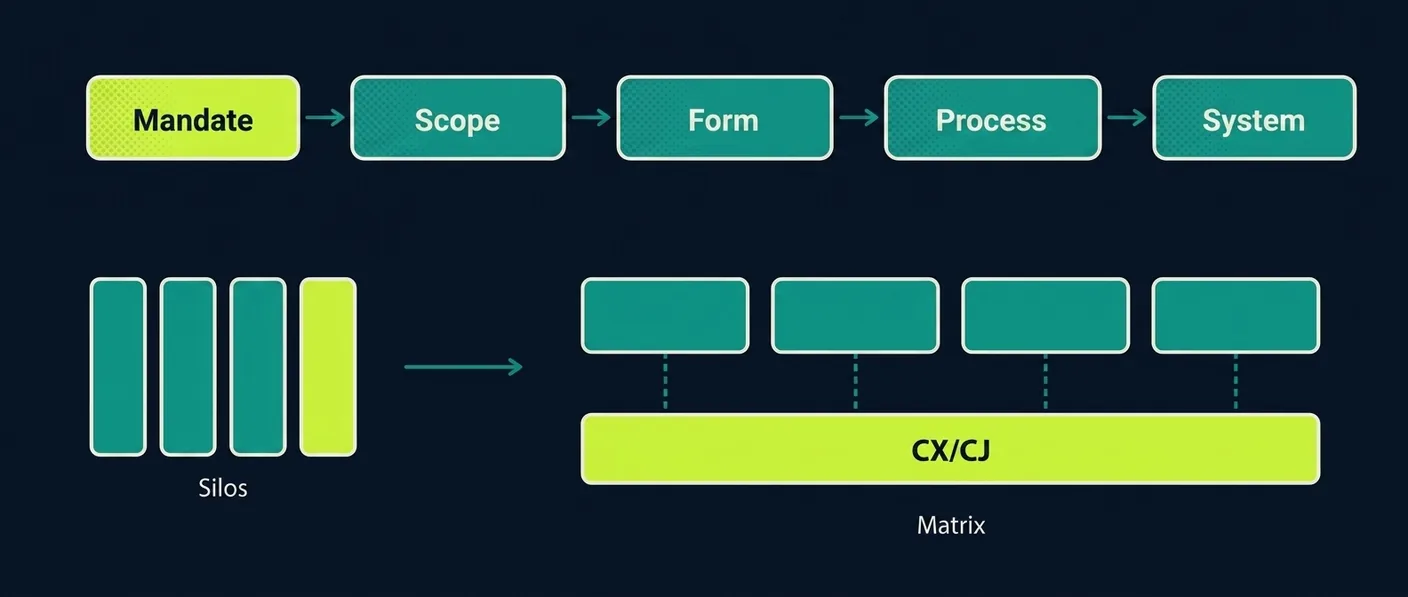
The process is defined before the tool. Only once the structure and the responsibilities are settled does the sequence become clear: how journeys are identified, how they are prioritised, who decides, what the lifecycle of a journey looks like, who owns which touchpoint. The tool comes after that.
This order is reversed almost every time, and the reason is understandable. A tool is visible, purchasable, and it suggests progress. A process is none of those things. What the reversal produces is a system that formalises a process nobody ever agreed on, and whose upkeep then falls to the function that needed it least.
07How does a silo become a matrix?
The function only has effect once it runs across the units. The last step is the one that either carries it or finishes it. A new CX/CJ unit starts life as another silo, alongside the business units and alongside IT. In that position it can advise and it can measure. It cannot steer.
Effect starts with a dotted line into every unit. That is not a CX decision. It is an organisational one, and it leads back to the person who signed in the first step. Which is why the mandate stands at the beginning and not as a formality.
08Where does the build tip over?
The build rarely tips over in the middle. It tips over at the start, and you see it later.
- 01The sponsor is nominal. They agreed, without understanding that agreement means conflict later.
- 02The budget is borrowed, from a digitalisation programme. The function's priority now hangs on that programme's goals rather than on customers.
- 03The boundary list was never written, because in the mood of the launch it would have looked petty.
Each of these three is unremarkable at the moment of the decision and no longer correctable at the moment it matters.
09When is a coordination role the right answer?
Not every organisation needs a CX/CJ function, and we say so even when it argues against the engagement. Where the digital presence hangs on a single channel, where one person runs the entire platform, or where the organisation is in the middle of a structural or system change that absorbs every available hand, building a dedicated function is premature. A named coordination role with a clear, small remit delivers more there than an apparatus with ambition and no backing.
We judge it on three signals.
- 01Several units treat the same customers differently.
- 02Systems hold the same customer data more than once, and inconsistently.
- 03Nobody can say who answers for a given customer metric.